Category Archives: SANSAD Events
Environmental Forum – July 8, 2014

Public forum on climate change
FACING CLIMATE CHANGE DISASTERS:
WHAT MUST BE DONE
Saturday, July 26 2.00 pm – 5.00 pm SUR 3280: SFU Surrey Campus
250-13450 102nd Avenue (Across from Surrey Central transit station)
There is no doubt anymore that we are facing an unprecedented moment in the history of humanity because of climate change. The scientific evidence is also clear that this has been induced by our use of fossil fuels over the last 200 years.
The UN Intergovernmental Panel on Climate Change (IPCC) came out at the end of March with devastating conclusions about irreversible changes that will cause enormous distress. Later reports on the melting of Antarctic ice also indicate irreversible changes that will substantially raise sea levels.
In the face of overwhelming evidence governments have been taking at best half-measures or promoting further production and use of fossil fuels. That is because the rest of us, the people who alone can compel governments and corporations to change course, have been content with business as usual.
We need to understand the issues to make changes in our lives and make governments change their policies in the interest of our well being and for future generations. Please join us at this important public discourse on climate change impacts and our responsibility for sustainable environment.
Panelists: Dr. Harun Rashid (report on the science of climate change), Seth Klein (climate justice), Harsha Walia (climate refugees and refugee rights), Dr. Mohammad Zaman (adapting to climate change), Dr. Summer Pervez and Dr. Chinmoy Banerjee (everyday living for sustainable life).
RSVP for registration: Chin Banerjee, cbanerjee@telus.net; Mohammad Zaman, mqzaman.bc@gmail.com
Organized by the South Asian Network for Secularism and Democracy (SANSAD) and Society for Bangladesh Climate Justice (SBCJ) with the support of the Institute for Diaspora Research and Engagement (IDRE), Canadian Centre for Policy Alternatives (CCPA), Dr. Hari Sharma Foundation (HSF), Greater Vancouver Bangladesh Cultural Association (GVBCA), Vancity, Prrogressive Intercultural Community Services(PICS), and Institute for the Humanities, SFU.
Hari Sharma Memorial Lecture 2014
Sanjay Kak
“ Martyr and Witness: Reflecting on Kashmir”
And Conversation on Kashmir with David Barsamian
Monday, March 31, 5,30 pm – 8.30 pm
1420-1430 Segal Centre, SFU Harbour Centre, 515 West Hastings Street, Vancouver
What does it mean to witness the continuing trauma of Kashmir, in a state of insurgency of varying intensity since 1989 and with some 600,000 troops maintaining a regime of impunity, where truth is buried deep every day, and in ever more complicated ways? Using excerpts from his 2007 film, Jashn-e-Azadi (How we celebrate freedom) documentary filmmaker Sanjay Kak reflects on his experience of the most recent phase of Kashmir’s elusive search for freedom, for Azadi.
Based in New Delhi, Sanjay Kak’s many award-winning films include In the Forest Hangs a Bridge (1999) about building a bamboo bridge in North East India, Words on Water (2002) on the struggle against big dams on the Narmada river Jashn-e-Azadi (2007) on the freedom struggle in Kashmir, and the recent Red Ant Dream (2013) on the persistence of the revolutionary ideal in India. He has edited the anthology of Until My Freedom Has Come: The New Intifada in Kashmir (2013) and is active in the documentary film movement, the Cinema of Resistance project and the Campaign Against Censorship.
David Barsamian, one of the most respected and influential broadcasters on alternative radio in North America is the Director of Alternative Radio in Boulder, Colorado. In the Vancouver area AR can be heard on CFRO, 100.5 FM, Wednesdays @ 1200 noon. He has interviewed Noam Chomsky, Eqbal Ahmed, Howard Zinn, Tariq Ali, Arundhati Roy, Edward Said, and Sanjay Kak, among many others. His latest book is Power Systems: Global Democratic Uprisings and the New Challenge to U. S. Empire with Noam Chomsky (2013). Though he had been traveling to India for more than forty years, studying music and interviewing people, he was deported on arrival from Indira Gandhi Airport in New Delhi in 2011. He was scheduled to interview Dr.Binayak Sen, who had been falsely incarcerated on the charge of sedition as well as following up on the discovery of more than 2000 unmarked graves in Kashmir. To date he is banned from visiting India.
Admission is free.
RSVP for registration: Chin Banerjee: cbanerjee@telus.net
Hari Sharma Foundation, www.harisharma.org, supported by South Asian Network for Secularism and Democracy (SANSAD) and South Asian Film Education Society (SAFES).
The Legacy of Ghadar: A Centenary Celebration
Public Forum and Film Screening
October 6, 2013
10.30 am – 5.30 pm
SFU Harbour Centre
515 West Hastings Street, Vancouver
One hundred years ago immigrants from British India on the west coast of North America, from Vancouver to San Francisco, working on farms and in saw mills or teaching and studying in universities came together in the Finnish Socialist Hall in Astoria, Oregon, to found the Ghadar (Rebellion) Party. Their goal was to liberate India from British colonialism by armed struggle as the Americans had freed themselves from the British nd the Finns from the Russians. This was the culmination of work that had been going on in London, New York, Berlin, Shanghai, and Tokyo to build revolutionary centres to support the struggle for liberation in India.
The Ghadar Party brought together intellectuals like Lala Hardyal from Delhi, Taraknath Das from Calcutta, V. G. Pingley from Poone, P. S. Khankoje from Wardha, Maulana Barkatullah from Bhopal and workers and students from Punjab like the mill-worker founding president of the party, Sohan Singh Bhakna and the young student at the University of California at Berkeley, Kartar Singh Sarabha, who printed the party paper, Hindustan Ghadar.
The Ghadar Party was linked to many movements, including the anti-colonial struggle in Ireland, the anti-imperialist struggle of Pan-Islamism, the militant nationalist struggles in Punjab, Maharashtra and Bengal, and the struggle against racial discrimination in the US and Canada, which would come to a head in the Komagata Maru incident in 1914. Its driving ideas came from anarchism, Marxism, and Sikhism. It sought liberation and social justice locally, nationally, and internationally.
The immediate goal of the Ghadar Party, the bringing about an armed insurrection in India along the lines of the Uprising of 1857, was not realized and many of its leaders were imprisoned and hanged: V.G. Pingle, Kartar Singh Sarabha, and Pandit Kansi Ram were hanged in Lahore Jail in 1915. But their legacy inspired other revolutionaries, including Bhagat Singh, who carried the picture of the nineteen-year old martyr, Kartar Singh Sarabha, with him. This is the legacy that the South Asian diaspora needs to celebrate and seek inspiration from in the ongoing struggle for liberty and justice in Canada, India and the world.
The Legacy of Ghadar
October 6, 2013
Programme:
Public Forum: 10.30 – 12.30 pm Rm. 2270 Sauder Policy Room
Moderator: Zahid Makhdoom
Panel: Bedabrata Pain, Prabhjot Parmar, Raj Pannu, Sadhu Binning, Setty Pendakur, Summer Pervez
Zahid Makhdoom is a Provincial Court Judge in British Columbia and a Director of Hari Sharma Foundation.
Bedabrata Pain is a NASA engineer and filmmaker based in California. He is the writer/director of the film CHITTAGONG that will be screened following the public forum.
Prabhjot Parmar teaches English at University of Fraser Valley and is a women’s rights and dalit rights activist.
Raj Pannu is Professor Emeritus at University of Edmonton and was MLA and leader of the NDP in Alberta.
Sadhu Binning is a retired teacher at University of British Columbia, a poet, writer, and community activist.
Setty Pendakur is Professor Emeritus at University of British Columbia. He was the first South Asian to be elected to political office in Canada when he became a city councillor in Vancouver in 1972.
Summer Pervez teaches English at Kwantlen Polytechnic University. She is also a student at Vancouver Film School and an activist for peace and social justice.
Lunch Break: 12.30 – 2.00 pm
Film Screening: 2.00 –5.30 pm Rm. 7000 Earle & Jenny Lohn Policy Room
CHITTAGONG: written (with Shonali Bose) and directed by Bedabrata Pain, 2012, winner of several awards.
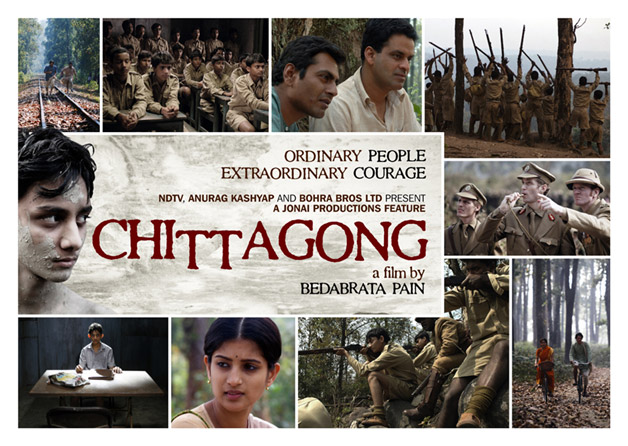 Directed by Bedabrata Pain, 2012, Hindi with English subtitles. 105 mins.
In 1930 a group of students led by a teacher, Surya Sen (Master Da), raided the armoury in the East Bengal city of Chittagong and took over the government of the city. Though some of them were captured others continued to fight for some years before all of them were killed, captured, sent to the penal colony in Andamans, or hanged. Women played an important part in this struggle.
The film CHITTAGONG retrieves a memory of an armed anti-colonial struggle in Bengal that is all but forgotten. It is part of the same movement for revolutionary overthrow of colonial rule in which the Ghaderites before them and Bhagat Singh, contemporaneously with them, were involved but one that both India and Bangladesh have chosen to forget.
The film will be introduced by Bedabrata Pain, who will also do a Q & A after the screening.
Organized by South Asian Network for Secularism and Democracy in partnership with South Asian Film Education Society and financial support from Hari Sharma Foundation.
The programme is free to the public.
For further information and to reserve seats contact: Chin 604-421-6752
‘s Struggles in Neo-liberal India
SANSAD Public Forum with
Dr. Navsharan and Dr. Atul Sood
September 2, 2013
Cafe Kathmandu
2779 Commercial Drive, Vancouver
1.30 pm – 3.30 pm
Dr. Navsharan works with International Developmental Research Centre, Canada, in New Delhi. She is a long-time activist in women’s and human rights movements and has written extensively on these issues. She will speak on Repression, Sexual Violence, Impunity, and Women’s Struggles in India Today.
Dr. Atul Sood teaches at Jwaharlal Nehru University in New Delhi. He has researched and written extensively on Developmental issues, particularly in Punjab. His current research is on the impact of neoliberal globalization on uneven economic and social development in India. He has recently edited Poverty Amidst Plenty: Essays on the Trajectory of Development in Gujarat, which has received critical acclaim. Dr. Sood will speak on Politics of Public Policy in Neoliberal India: Struggles for Rights and Entitlements.
The event is free to the public.
For further information call Chin Banerjee: 604-421-6752
Supported by Dr. Hari Sharma Foundation and Gursharan Singh Memorial Lecture Committee
Pakistan Elections 2013: The Economic Challenges Facing the New Government
SANSAD Public Forum with
Dr. Kamal Munir
Saturday June 8, 2013, 6.00 pm-8.30 pm
Collingwood Neighbourhood House
5288 Joyce Street, Vancouver
(Close to Joyce St. Station; underground parking off Euclid Avenue)
Pakistan recently has been through historic elections in which one civilian government has been followed by another. It is faced with enormous and diverse challenges. Dr. Munir will highlight the economic challenges that face the new government in Pakistan. Considering the policies that the government is likely to adopt, he will offer his assessment of the grounds for optimism on the economic front.
Dr Kamal Munir is a Reader in Strategy & Policy at the University of Cambridge, where he has been teaching since 2001. Dr Munir has published numerous articles in leading journals, and presented his work at numerous international conferences. At the same time, he has written numerous articles for newspapers and magazines including the EPW (Economic and Political Weekly) Financial Times, The Guardian, Newsline, Dawn and several others. He has been a consultant or trainer for the World Bank; the Department of Trade and Industry, UK; the Asian Development Bank; the Government of Pakistan, and the State Bank of Pakistan.
Moderator: Haider Nizamani. Respondent: Zahid Makhdoom.
Organized by South Asian Network for Secularism and Democracy (SANSAD) and co-sponsored by Committee of Progressive Pakistani Canadians (CPPC).
For more information contact: Chin Banerjee, 605-421-6752.
RACISM TODAY
In Memory of the Gurdwara Killings in Wisconsin and the attacks on mosques in the US
SANSAD Public Forum
Saturday, September 8, 2012
2.00 pm- 5.00 pm
Room 2245
Simon Fraser University, Harbour Centre, 515 W Hastings Street, Vancouver
Panelists:
Harsha Walia (noii), Indira Prahst (Langara College), Itrath Syed (Simon Fraser University), Tony McAleer (former Skinhead; Life After Hate)
Moderator: Summer Pervez (Kwantlen Polytechnic University)
The racist killings of 6 people in the Oak Creek Gurudwara on August 5 shocked people across the world and drew widespread condemnation. This was followed by attacks on several mosques, including the burning of a mosque in Missouri. These attacks are the culmination of hundreds of attacks on the Sikh and Muslim communities in the US since Sept 11, 2001. These racist attacks need to be placed in the perspective of the wider social and political scene that enables them. We must think of what we need to do to end such violent expressions of hate and the systemic construction of threatening aliens among us.
For more information contact: Chin Banerjee: 604-421-6752
Supported by: Committee of Progressive Pakistani Canadians (CPPC) and SFPIRG.
First Nations and South Asians
SANSAD Public Forum
Sunday July 29, 2012
4.00 pm-6.00 pm
Café Kathmandu, 2779 Commercial Drive, Vancouver
It is unfortunate that the South Asian community is generally poorly informed and not responsive to the issues of the First Nations in Canada. South Asians, who have historically experienced and struggled against colonialism in their homeland and honour the heroes of this struggle could be expected to empathize with the original and continuing victims of colonialism in Canada. And as a people who have experienced, struggled against, and continue to struggle against racism, they could be expected to stand in solidarity with the aboriginal people who continue to be the greatest victims of racism in Canada. But the enjoyment of benefits based on the dispossession of the aboriginal people has made us stay away from the concerns of the First Nations. How can we overcome our complicity in injustice and learn to stand in solidarity with oppressed aboriginal people? South Asian Network for Secularism and Democracy invites the public to a discussion and exploration of this urgent question.
Panel
Joint Keynote Speakers: Dr. Ronald Ignace (former Chairman of Shuswap Nation Tribal Council, Chief of Skeetchestn Band and Adjunct Professor at Simon Fraser University) and Dr. Marianne Ignace (Professor of Anthropology and First Nations Studies, SFU)
Raj Chouhan (MLA Burnaby-Edmonds)
Gurpreet Singh (Host of Radio India)
Sadhu Binning (Poet and writer)
Moderator: Zahid Makhdoom
For more information contact Chin at 604-421-6752
Media and Democracy
SANSAD Public Forum with David Barsamian
April 15, 2012
2.00 pm-5.00 pm
Room 1700, SFU Harbour Centre
515 West Hastings Street, Vancouver, BC
David Barsamian is the founder and director of Alternative Radio, the independent weekly audio series based in Boulder, Colorado, a nationally syndicated program carried by 125 radio stations.
He has interviewed and authored books with Noam Chomsky, Howard Zinn, Eqbal Ahmad, Tariq Ali, Arundhati Roy and Edward Said. His best-selling books with Chomsky have been translated into many languages. His latest books are How the World Works and What We Say Goes (both with Noam Chomsky) and Targeting Iran. David’s interviews and articles appear in The Progressive, Z and other publications.
Barsamian is winner of the Media Education Award, the ACLU’s Upton Sinclair Award for independent journalism, and the Cultural Freedom Fellowship from the Lannan Foundation. The Institute for Alternative Journalism named him one of its Top Ten Media Heroes.
Barsamian, who had visited India many times in the last 40 years, reporting on conditions, learning Urdu and playing sitar, was deported on arrival in New Delhi on September 23, 2011 and prevented from carrying out scheduled interviews in regard to the thousands of recently discovered unmarked graves in Kashmir and with Dr. Binayak Sen, who had been imprisoned for years as a Maoist-sympathizer for rendering medical assistance to insurgents in India’s tribal areas.
David Barsamian will discuss world affairs, the economic crisis and global rebellions, the state of journalism, and censorship.
For further information contact Chin Banerjee: 604-421-6752.
Co-sponsored by Committee of Progressive Pakistani Canadians (CPPC) and Progressive Nepali Forum in Americas (PNEFA).