Category Archives: Solidarity Links

Retired civil servants protest rising intolerance

The Hindu
thehindu.com
Updated: March 21, 2016 18:37 IST

Retired officers express concerns over rising ‘intolerance’

Seventeen retired officers of the All India and Central Services have made a public appeal regarding the general spirit of intolerance that pervades the atmosphere.

Citing examples of recent clamp downs in various educational institutions, murder of rationalists Kalburgi, Narendra Dabholkar and Govind Pansare, and explicit comments made by ruling party leaders against minorities, the former IAS officers wrote: “We add our voice to the multitude of dissents already expressed and call upon all right-thinking people to register their protest at the current goings-on.”

They have sent the appeal to the President and the Prime Minister’s Office.

Full text of the public appeal

We, the persons listed below, a group of retired civil servants belonging to different All India and Central Services who have worked in the Government of India (GoI), State Governments and a wide range of governmental and other institutions would urge all Constitutional institutions in India, the media and the general public to reflect upon the deeply disquieting trends visible in the public sphere and in our polity today. These developments are causing deep anguish to us as they question some of the fundamental Constitutional principles and legal safeguards we have long taken for granted. Some of these are mentioned below:

1) The discrimination against Scheduled Caste students and an attempt to clamp down upon Ambedkar study groups as found in IIT, Chennai, and in the University of Hyderabad. The tragic suicide of Rohith Vemula has highlighted the unwarranted interference of the GoI in the University of Hyderabad and its targeting a group of students, who did not subscribe to a narrow concept of nationalism.

2) There is a systematic attempt to silence dissent using the outmoded law of sedition against young idealists like Kanhaiya Kumar and his colleagues, who have given India a wake-up call to address poverty and all forms of exploitation.

3) Law and order agencies like the Delhi police used doctored videos in a blatantly partisan manner against JNU students while an MLA and certain lawyers – who were widely caught on camera beating up Kanhaiya and journalists – were treated with kid gloves. Even the team of senior lawyers nominated by the Supreme Court to monitor the situation reported the atmosphere of threat and intimdation.

4) The atmosphere of intolerance is growing what with the murder of the rationalists and the regular threats of violence against minorities and all who do not accept a very narrow version of ‘nationalism’. Such a concept of nationalism is itself grounded in a biased view of history. This intolerance is a direct attack upon the freedom of speech and expression and is anathema to the pluralism of the Indian Constitution.

5) A Minister in the Central Government, a ruling party MP and local leaders have recently issued terrifying threats against Muslims but the GoI does not find anything objectionable in the Minister’s statements. Other minorities have also expressed their sense of insecurity.

What is listed above is only illustrative. We feel that all told, there is a clear and present danger to the values of the freedom of speech, thought and expression as also the pluralism and the secularism that are basic to the Indian Constitution. We add our voice to the multitude of dissents already expressed and call upon all right-thinking people to register their protest at the current goings-on.

At the same time, we would like to point out that we do not condone similar transgressions by other groups – particularly on the extreme left – which try in like manner to silence opposing views by vicious attacks on social media and/or violence.

We urge a return to the civilized and civilizational discourse of the Constitution of India and a renewed public commitment to the freedom of speech, thought and expression.

Yours faithfully,

1) Niranjan Pant, IA&AS (R), former Deputy Comptroller & Accountant General, GoI

2) EAS Sarma, IAS (R), former Secretary, Department of Economic Affairs, Ministry of Finance, GoI

3) Ruchira Mukerjee, Indian P&T Accounts & Finance Service (R), former Adviser (Finance), Telecom Commission, Department of Telecom , GoI

4) Kalyani Chaudhuri, IAS (R), former Additional Chief Secretary, Govt. Of West Bengal

5) Keshav Desiraju, IAS (R), former Secretary, Ministry of Consumer Affairs, GoI

6) Amitabha Pande, IAS (R), former Secretary, Inter-State Council, GoI

7) Ardhendu Sen, IAS (R), former Chief Secretary, Govt. Of West Bengal

8) Pranab Mukhopadhyaya, IAS (R), former Director, Institute of Port Management, GoI

9) Surjit Das, IAS (R), former Chief Secretary, Govt. of Uttarakhand

10) Anup Mukerji, IAS (R), former Chief Secretary, Govt. of Bihar

11) Vibha Puri Das, IAS (R), former Secretary, Ministry of Tribal Affairs, GoI

12) SS Rizvi, IAS (R),former Joint Secretary to the GoI

13) Sundar Burra, IAS (R), former Secretary, Govt. of Maharashtra

14) Harish Chandra, IAS (R), former Prinicipal Adviser in the rank of Secretary, Government of India (GoI)

15) Kamal Jaswal, IAS (R), former Secretary, Ministry of Information Technology, GoI

16) Meena Gupta, IAS (R), former Secretary, Ministry of Environment and Forests, GoI

17) Hirak Ghosh, IAS (R), former Principal Secretary, Govt. Of West Bengal

Chaman Lal, JNU alumnus returns award


To protest against attack on JNU,the best academic institution of the country and one of the best in world,As an alumnus and retired faculty member from JNU,I am returning MHRD award given to me by Former Prime Minister Atal Behari Vajpayee,with then MHRD minister Dr. M M Joshi on 30th April 2003 for year 2000-01. Reasons in detail given in letter to MHRD minister in attached file.

  Honourable President and Chief Justice of India   

   For your kind attention                           

     I also know full well that by returning the award, I am again putting myself to danger of a vendetta at the hands of MHRD minister and this government, which is known for not showing any respect to even Vice Chancellors of the Universities. Thus I will be sending copies of my letter to the President of India and the Chief Justice of India, so that if anything happens to my life or limb, because of my protest against the attack on JNU, this government shall be held responsible.                                                  


Professor Chaman Lal (Retired)                                           Dated: — 20th February

Professor& Former Chairperson

Centre of Indian Languages (SLL&CS)

Former Visiting Professor, The University of the West Indies, Trinidad Tobago

Former President JNUTA

Jawaharlal Nehru University, New Delhi-110067


MHRD, Shastri Bhavan

New Delhi


Director

Central Hindi Directorate,

New Delhi 

Subject: Return of 2000-01 ‘Non Hindi speaking area Hindi writer Award’

  Dear Sir/Madam,

I have no idea who is heading the Directorate these days, so am addressing this letter unnamed.

You can see from your records  that I was given the ‘Non Hindi speaking area Hindi writer Award’  on 30th April 2003 by the then Prime Minister, Sh. Atal Behari Vajpayee. The then MHRD minister Dr. M M Joshi had presided over the function. I am attaching some photographs of the event for your convenience.

This award was given to me for my translation of selected poetry of Punjabi poet Surjit Patar – ‘Kabhi Nahin Socha Tha’ – in Hindi from my mother tongue Punjabi. Incidentally Surjit Patar returned his Sahitya Akademi award along with other 12 Punjabi writers last October to protest against the assassination of Dr. M M Kalburgi.

This was my first state award.  Later, I was awarded the ‘Sahitya Akademi Prize for Translation’ for the year 2001 for the translation of the Punjabi poet Pash in Hindi (Pash was assassinated by Khalistanis) and the ‘Punjab State ‘Shiromani Hindi Sahitkar’ Award for year 2003, apart from innumerable honors from public institutions in India and abroad.

With the social conditions in the country worsening day by day the assassination of Dr. M M Kalburgi, Sahitya Akademi award winner, by some extremist religious body activists led many of our writers to protest by returning their state awards, especially Sahitya Akademi awards. I also joined my fellow writers in solidarity and returned my prize on 12th October 2015. Incidentally, all three awards came to me during the NDA regime in the centre -1999-2004. These awards were returned because of the atmosphere of extreme intolerance created in country after 2014, in the name of ‘Cow’, ‘beef’, ‘nationalism’ etc. Govind Pansare and Dr. Narender Dabholkar and many more had already become victims of these extremist religious groups, as was Punjabi Poet Pash in 1988 at the hands of Khalistani terrorists. No effort was made to check and control these elements, rather many ruling party MP’s were aggravating the crisis by supporting these elements, which included glorification of Mahatma Gandhi’s murderer, Nathuram Godse.

Incidentally Mahatma Gandhi may be dubbed as the ‘first anti national’ of independent India, as he fasted for releasing 55 crore rupees due to newly created state of Pakistan, with the partition of India in 1947. In fact, slogans now being heard on Delhi roads – ‘Desh Ke Gaddaron ko goli maro’(Shoot the traitors of the country) against  JNU students these days  were raised against Mahatma Gandhi in those days and ultimately he was assassinated by those who were  inciting people with these slogans. Ironically Mahatma Gandhi had not joined the celebrations of independence in Delhi on 15th August, as he was fasting in Noakhali with his loyal followers like Bibi Amtus Salam to control the devil of communal riots. Mahatma Gandhi who at one time wished to live for 125 years, expressed his wish at that time ‘not to live anymore’ after seeing the level of communal clashes in country. The assassin of Gandhi is a hero of today’s Hindutva forces, patronized by this government despite paying lip service to Gandhi.

We hundred plus awards returning writers/artists/filmmakers and other citizens were hoping that things will improve after our protest, but our hopes proved illusory. Not only were we derided and insulted, including 88-90 years old respected writers/scientists-Krishna Sobti, Nayantara Sehgal and P M Bhargava, we were charged with being Congress agents, favourites and leftists, who got undue awards during previous regimes and were now ‘intolerant’ of new the government. In my case, if at all I was ‘favoured’, it was not during the Congress regime, but the previous NDA regime.

In October 2015, JNU and other university students started #OccupyUGC campaign which was dealt with by a rather heavy hand and then Central University of Hyderabad students started an agitation against discrimination of Dalit students, which were dealt so harshly that one of the brightest research scholars of the University, Rohith Vemula was forced to commit suicide on 17th January 2016. Support for Rohith Vemula engulfed the whole country. Earlier, FTII Pune students were being treated very harshly. In this connection, when after a function in Jawaharlal Nehru University was held on 9th February, about which some controversy arose, JNU Students Union’s elected President Kanhaiya Kumar was picked up by the Delhi police and charged with Sedition! This naturally led to a massive student protest not only in JNU, but all over the country and JNU Teachers Association (JNUTA) also extended its support. To make the things worse, irresponsible statements were given by Home Minister, MHRD Minister and Delhi police chief, which led to brutal attacks on not only Kanhaiya Kumar inside the court, but on media men also by some black coat wearing goons. Most dangerous was the open violation of Supreme Court’s directions and mistreatment of six lawyers sent by Supreme Court by certain black coated hooligans inside the court. This has never happened even during British colonial regime. Bhagat Singh was beaten inside the court by British police, but never by unruly hooligans with police patronization.

Even in JNU history, such horrible police interference never took place. I myself have been victim of emergency, spending seven months in prison and getting my admission to JNU delayed for two years, despite being selected. Yet I can say today that despite Indira Gandhi’s authoritarianism, she was correct in her understanding of certain Hindutva groups, as was her father,Jawaharlal Nehru. These groups collaborated with British colonialism during the freedom struggle and played the game of dividing Indian national unity by creating communal rifts, which was criticized by none else than Bhagat Singh. These are the people who have now come to power by deceiving people with deceptive slogans and playing the same colonial days game of dividing people and creating communal violence, just to acquire and preserve power.

The most ominous sign of their dangerous game is of involving army people and inciting their families in the name of ‘nationalism’ and pitting them against JNU. Worse still people not related to JNU were incited by BJP MP Sadhvi Prachi and they entered the University with the University officials’ shameful collaboration and tried to terrorize the JNU community. At least Jadavpur University faculty and students foiled such attempt by ABVP directly patronized by MHRD minister, which has already caused the suicide of Rohith Vemula in Hyderabad, by making a massive human chain at the University gate. I am afraid that  with the kind of head hunting going on for JNU students, if another tragedy like that of Rohith Vemula occurred, I shudder to think of its reaction all over the country.

I have not only retired as Professor from JNU, I have been JNUTA President during year 2007, I am also a JNU alumnus, remaining a student during 1977-82 and getting my PhD degree from this University. It was but natural that I got disturbed, upset and anxious at the happenings in JNU and outside, vilifying my ‘alma mater’ in the worst manner. Further, the MHRD minister’s own conduct during the Rohith Vemula movement and during the attack on JNU has been most vindictive towards the University. She was having a grouse against the students of JNU due to their #OccupyUGC and #StandWithRohith movements, which has embarrassed her own self and her government throughout the world. She could not attack JNU, during the term of outgoing VC Prof. S K Sopory, who never allowed police to enter campus and dealt with such problems, even like the present one of alleged ‘anti national’ sloganeering, at the University level itself. That is why the whole University – students, faculty and staff – supported him for his democratic and dedicated administrative conduct.

The MHRD minister was itching for revenge so she got a new VC of her choice, pliant to her whims and within two weeks of his taking over, he allowed police to enter campus, on the basis of a controversial video complaint filed with Delhi police, without even any preliminary enquiry at University level. He violated even the JNU standard procedures of taking into confidence Deans and Chairpersons of Schools/centers. Four senior Deans protested on his allowing the police in campus and they joined the JNUTA call for solidarity with JNUSU.

In a similar situation at Jadavpur University, the Vice Chancellor categorically declared that he would not file any complaint with the police nor allow police to enter campus and settle the issue at university level. He rather stood with the Jadavpur faculty and students in a human chain to stop anti-social elements entering the campus. In contrast, JNU VC allowed the police with open arms, following the example of his ideal Hyderabad University VC, Appa Rao. In fact, sending police inside JNU campus on the basis of a suspicious video of a discredited news channel, directly interfered with the autonomy of the university. The JNU administration could have dealt with this problem using JNU’s internal mechanism without creating a national crisis. It seems the Central government was rather keen to create this crisis and they did it through their pliant new VC.

Under such circumstances, my conscience has been pricking me since the arrest of the JNUSU President and I can no more bear the burden on my conscience. I am thus returning the award given to me directly from MHRD with the signature of then MHRD Minister Dr. M M Joshi, since the Central Hindi Directorate is a branch of higher education section of MHRD. When the MHRD with the Govt. of India’s express wish, is bent upon destroying my alma mater JNU, which is considered the best University of the country and which is appreciated by world renowned scholars like Noam Chomsky, Nobel prize winning writer Orhan Pamuk and innumerable scholars from hundreds of Universities from India and abroad, then the least I can do is to record my protest by returning the award, which was given to me by MHRD itself 15 years ago, by the same NDA govt., which is in power today!

I shall hand over the plaque and a cheque of fifty thousand rupees given to me as part of the award to your office. I understand, you have no role in all this tragic happenings in JNU, but I request you to forward my letter and cheque to the MHRD, so that my protest is registered in records of MHRD. Since the procedure of award is through your office, I am submitting my award back to your office for necessary action of either forwarding or dealing with it at your own level. Since your office declined to accept cheque, memnto, shawl and certificate, I have sent ti through speed post on 25th February.

   I also know full well that by returning the award, I am again putting myself to danger of a vendetta at the hands of MHRD minister and this government, which is known for not showing any respect to even Vice Chancellors of the Universities. Thus I will be sending copies of my letter to the President of India and the Chief Justice of India, so that if anything happens to my life or limb, because of my protest against the attack on JNU, this government shall be held responsible. 

 Returning state awards and honours form is considered the most decent form of protest the world over and people are respected for it, even by those in power. Yet during the return of my first award, I have been subjected to all kinds of indignities on television and on social media by trolls. This happened despite the fact that out of my fifty plus books in Hindi, Punjabi and English, some translated into Urdu, Marathi, Bengali, Telugu, Gujarati etc, nearly fifteen books are related to Bhagat Singh and other revolutionary freedom fighters. But my ‘nationalism’ is under question under this government, which has no record to show of its ‘nationalism’ by way of any role in freedom struggle of its party or its ancestors! I have my own ‘Nationalism’, based on Bhagat Singh’s ideas of exploitation free Socialist India, further based on Gandhi’s nationalism of ‘Communal Harmony’, Nehru’s nationalism of ‘Scientific Temper and Knowledge’, Ambedkar’s nationalism of ‘Social Justice/equal rights/status/dignity for Dalits/Adivasis’, Subhas Bose’s nationalism of ‘Socialist India, all of whom have fought for the freedom of this ‘Nation’ from British colonialism. I certainly disapprove the so called ‘Nationalism’ of RSS/Hindutva thinkers like Golwalkar and Savarkar, who either did not participate in the freedom struggle or abjectly apologized ample times, of ‘Communal Divide and violence against minorities/Dalits’, leading to one BJP MLA in Rajasthan having the audacity to demand Rahul Gandhi ‘be shot dead/hanged for treason’! And another BJP leader asking for ‘beheading him and putting his head at JNU gate’! I don’t think that there is any difference between ISIS statements and actions in their Caliphate in Syria-Iraq,  and these statements if not yet turned into action!

                I may disagree with Rahul Gandhi’s politics, but his great great grandfather Motilal Nehru, his great-grandfather Jawaharlal Nehru,his great grand-mother Kamla Nehru, his great grand aunti-uncle-Vijaylakshmi Pandit/Ranjit Pandit, his grandmother Indira Gandhi- all suffered imprisonment during the freedom struggle in contrast with these ‘phony nationalists’! So much for their zeal to kill people in the name of their own concept of ‘nationalism’, which means subjecting citizens to their narrow and sectarian religious kind of nationalism, which has no place for secular enlightened knowledge based scientific temper, so dear to Jawaharlal Nehru, on whose name JNU was established and which is being destroyed by present dispensation by all means, as already Nehru Memorial Museum and Library(NMML), National Book Trust(NBT), and ICHR have been destroyed by anti-knowledge ministers of HRD and Culture! Yet, like thousands of JNU alumnus, present faculty and students, I #StandWithJNU and am ready to pay whatever price this government wants me to pay, even getting killed by some of their patronized ‘nationalists’!

Yours Sincerely,


(Chaman Lal)

Winner of 2000-01 award for Non Hindi speaking area Hindi writer

  1. no. 2690, Urban Estate, Phase-2, Patiala (Pb.)-147002

Prof.chaman@gmail.com 09646494538


H.No.2690, Urban Estate, Phase-II, Patiala (Pb.)-147002


Email: – prof.chaman@gmail.com mobile no 09646494538


Chaman Lal,

Professor(Retired), JNU, New Delhi

Former President JNU Teachers Association(JNUTA)
Cell no. +919646494538

Blogs-www.bhagatsinghstudy.blogspot.com
www.drchaman.wordpress.com
www.twitter.com/ProfChaman
www.facebook.com/Dr.Chaman.JNU
http://in.linkedin.com/in/chamanlaljnu

https://jnu.academia.edu/ChamanJNU

https://www.researchgate.net/profile/Chaman_Lal2

https://scholar.google.com/citations?hl=en&imq=Chaman+Lal
Jammu and Kashmir civil society solidarity with JNU

FEBRUARY 18, 2016

Guest Post by Jammu Kashmir Coalition of Civil Society

Jammu Kashmir Coalition of Civil Society (JKCCS) expresses its solidarity with the striking students and teachers of Jawaharlal Nehru University, New Delhi. We have watched with a sense of horror and dismay, the violent criminalizing of student democracy and dissent, not just at Jawaharlal Nehru University but across Indian campuses in the recent past. Having long and intimate knowledge of violent repression and legalized impunity that Indian state is capable of, especially against those it considers ‘anti-national’ we are not surprised by these events, but have a special empathy with all who suffer its horrors. We demand the release of all student dissenters and political prisoners in the custody of the Indian state, and an end to acts of policing and surveillance on campuses, and targeting of students on the basis of political beliefs and speech.

The Kashmiri students in different colleges and universities in India, who have always faced discrimination and intimidation time to time, are now feeling the extreme regressive and oppressive means used by right wing groups and the government. After being hounded, Kashmiri students have begun leaving Delhi. There are several places where the landlords, in whose properties Kashmiri students were renting flats, have asked the students to vacate. These experiences of Kashmiri students are part of the larger reality faced by Kashmiri youth in Jammu and Kashmir and in India. The voices of dissent in Jammu and Kashmir have been dealt with administrative detentions under Public Safety Act, illegal detentions, torture, surveillance and killings by armed forces including the most recent one of Asif and Shaista at Pulwama on 14th of February.

We also view with alarm, the reports about the cynical use of Kashmiri students studying in Delhi as hostages in the politically illegitimate process of government formation in Srinagar.

We are dismayed that the public narrative about the recent events has often descended into disputes over Indian ‘patriotism’ and the shrill condemnation of a few ‘fringe’ ‘radical’ ‘traitors’ for ‘irresponsible’ slogans. These sentiments are neither mere slogans nor represent the ‘fringe’ in Kashmir, the very place they were made in reference to. As Kashmiris, we believe that the right to self-determination is inseparable from the right to political association, dissent and free expression, and these rights cannot be selectively asserted or upheld. In the competitive public proclamations of nationalistic credentials, what has been lost is that courageous act of defiant solidarity with the Kashmiri people’s struggle for justice and self-determination, that lies at the heart of these debates. Despite the disavowals and the state repression, the solidarity with the political rights of the Kashmiris is growing and spreading, as events in Jadavpur University demonstrate. We acknowledge the emerging spaces in Indian civil society to converse on the question of Kashmir, beyond nationalist framings. We hold out hope for future alliances with students, groups and individuals willing to engage in honest conversations, in which they alone do not determine the boundaries of what can or cannot be said, thought or felt.

Spokesperson
JKCCS

University students in New Delhi under attack

FEBRUARY 13, 2016

We, the undersigned, (educators, professors, intellectuals, writers and artists), are shocked by the appalling conduct of Delhi Police at Jawaharlal Nehru University in New Delhi yesterday. We also condemn the irresponsible sloganeering by some people at the fringes of a gathering on the JNU campus to mark the third anniversary of the execution of Afzal Guru. We believe that such calls to ‘war, until the destruction of India’ erode the gravity of any serious discussion on any political question, be it capital punishment, human rights or even the question of self-determination. Such conduct is shameful, regardless of who does it, and deserving of the sharpest criticism.

That said, the only way to counter such incidents, when they occur, is through a deepening of dialogue, not through police action. The police has no business to enter places of learning and harass students (including students who were clearly trying to defuse the situation and to take a stand against the irresponsible elements who gave the objectionable slogans) when there had been no breach of peace.

We condemn the arrest of Kanhaiyya Kumar, president of the Jawaharlal Nehru University Students Union on trumped up charges of sedition and demand that he be released immediately. Kanhaiyya’s public statements, which are widely available, clearly show that sedition is the last thing that you can charge him with. The University Authorities must take steps to ensure that the witch hunt that is ensuing against other students must also cease immediately. We are saddened by the new JNU Vice Chancellor’s readiness to submit to the diktats of the police, and we condemn the totally outrageous statements by the Union Home Minister Rajnath Singh, and the Minister for Human Resources Development Smriti Irani which virtually declare war on universities as spaces for dissent and debate.

We demand an unconditional withdrawal of police personnel from campuses, and reiterate our support and solidarity with the students, faculty and staff of JNU, and with students everywhere in India who are pursuing a courageous resistance against the ongoing assault on higher education unleashed by the BJP government.

Ashis Nandy, Distinguished Fellow, Centre for the Study of Developing Societies, Delhi

Bharti Kher, Artist, Delhi

Debjani Sengupta, Associate Professor, Department of English, Indraprastha College, Delhi University

Gauri Gill, Artist, Delhi

Gayatri Sinha, Curator, Delhi

Geeta Kapur, Curator, Delhi

Iram Ghufran, Filmmaker, Delhi

Jeet Thayil, Poet, Delhi

K. Satchidanandan, Poet, Delhi

Lawrence Liang, Alternative Law Forum, Bangaluru

Moinak Biswas, Professor, Department of Film Studies, Jadavpur University, Kolkata

Nandini Datta, Associate Professor, Miranda House, Delhi University

Neha Choksi, Artist, Mumbai

Pallavi Paul, Artist/Filmmaker, Delhi

Parnal Chirmuley, Associate Professor, Centre of German Studies, School of Language, Literature and Culture Studies, Jawaharlal Nehru University, Delhi

Rajarshi Dasgupta, Assistant Professor, Centre for Political Studies, Jawaharlal Nehru University, Delhi

Rajeev Bhargava, Director, Centre for the Study of Developing Societies, Delhi

Ravi Sundaram, Fellow, Centre for the Study of Developing Societies, Delhi

Romila Thapar, Historian, Emeritus Professor, Jawharalal Nehru University

Sahej Rehal, Artist, Mumbai

Sabina Kidwai, Associate Professor, AJ Kidwai Mass Communication Research Centre, Jamia Millia Islamia, Delhi

Sabeena Gadihoke, Associate Professor, AJ Kidwai Mass Communication Research Centre, Jamia Millia Islamia, Delhi

Sanjay Kak, Filmmaker, Delhi

Sarnath Banerjee, Artist, Delhi / Berlin

Saumyajit Bhattacharya, Associate Professor, Department of Economics, Kirori Mal College, University of Delhi

Sibaji Bandyopadhyay, Fellow, Centre for the Studies of Social Sciences, Kolkata

Shohini Ghosh, Professor, AJ Kidwai Mass Communication Research Centre, Jamia Millia Islamia, Delhi

Shuddhabrata Sengupta, Artist, Raqs Media Collective, Delhi

Subodh Gupta, Artist, Delhi

Vivan Sundaram, Artist, Delhi


The struggle for the land

The Mainlnder

http://themainlander.com/2016/01/28/the-struggle-for-the-land-a-view-from-the-philippines/

The Struggle for the Land: A View from the Philippines

Aiyanas Ormond January 28, 2016

Cenona Estrada, Chairperson of the Kaugmaon (Photo Credit: Martha Roberts)

This weekend Cafe Rebelde will be hosting The Struggle For the Land, an event that combines a photo exhibit, food, community theatre, followed by a discussion about the intersection of food sovereignty, global land struggle, and state repression. On this occasion we are publishing a new piece by Aiyanas Ormond, an organizer of the event. Over the years Ormond has spent time integrating with urban poor and peasant communities in the Philippines, most recently in the fall of 2015. Below is an account of Kaugmaon, an organization fighting for the land and community control on the Filipino island of Negros. For more information about the event see the bottom of this article. –Editors

“The principle of Kaugmaon is embedded in the struggle for the land. It is a struggle for survival for the members, and it is the undying hope of freedom and of victory at the end, that allows it to survive.”

Cenona Estrada needs to take courage where she can. She’s the chairperson of Kaugmaon, the peasant farmer’s organization on the island of Negros in the Philippines. Enrik Colago, the previous chairperson, was murdered along with his wife in an extrajudicial killing involving the Armed Forces of the Philippines, police, and paramilitaries. Toto Quirante, Enrik’s predecessor, was also killed by the military and his sister, Emilia Quirante – also once a Kaugmaon chairperson – spent 18 months in prison on trumped up charges.

This militarization and repression, familiar in so many other parts of the Global South, is driven by a basic conflict over land. It is part of a sharp struggle between, on the one hand, some three billion human beings who procure their livelihood through subsistence farming, fishing and hunting, and, on the other, the imperialist conglomeration of landowners, capitalist agribusiness, corporate resource extraction (particularly mining) and various forms of real-estate speculators.

It’s not a conflict that is much talked about or very well understood in the heartlands of the imperialist metropole, but globally it’s the central conflict fueling some of the boldest and most transformative struggles for liberation – as well as many of the worst instances of state repression.

Sugar workers in Negro, Philippines (Photo Credit: Martha Roberts)

There are painful indicators of the tremendous toll that ‘integration’ into the imperialist political economy takes on these communities, such as the elevated suicide rate of debt-burdened farmers in India (47% higher than the national average & 300,000 farmer suicides in the last 20 years) or the permanent condition of poverty in the slums of Cairo, Sao Paulo, Delhi and the other big cities where those driven off the land end up.

On the flip side is the struggles of rural communities for the right to survival, which in this case means land. From the militant organizing and land occupations of the Landless Peasants Movement (MST) in Brazil, to the struggles of rural and Adivasi people in India, to the Zapatista liberated communities, these struggles are a powerful challenge to imperialist hegemony, in part because they pose a concrete alternative to capitalist models of ‘development.’

A view from the Philippines

The immediacy and urgency of the struggle for the land is crystal clear in the mountains of the Philippines. In the Vasayan island of Negros, in the rural hinterland of the secondary city Guihulngan, Erlie Calago has lost both of her parents to this struggle. Her mother Rosalie and father Endrik were leaders of Kaugmaon. For families like theirs, land, survival, dignity and hope are deeply intertwined.

The progressive mass movement in the Philippines identifies their enemy as imperialism, feudalism and bureaucrat capitalism. Anyone who visits the area can quickly see that all three forces are in play in Guihulngan. Through feudalism – the old system of exploitation of peasants by landlords – tenant farmers must turn over a quarter, a third, or even of half of all they produce to the rich families that ‘own’ their lan, even though they may have never set foot on it. While this is a system that pre-dates capitalism, it is held in place by the legal framework of the modern Philippine State, whose military and police secure the property rights of the feudal landlords. Over the years Kaugmaon has waged a successful struggle to reduce the amount paid by peasants to their landlords, making the organization a target.

Peasant rally in the Philippines (Photo Credit: Martha Roberts)

Imperialism – domination by foreign governments and exploitation by foreign multinational corporations – is evident particularly in the hundreds of mining claims on the island. Large capitalist mining companies, including Canadian based and financed operations, lust for the rich mineral resources buried within the mountains of the province. Initially these developments require removal of the farming communities. This first wave of displacement is then exacerbated as the runoff from mining operations pollutes nearby farms and coastal waters, undermining the livelihood of farming and fisherfolk communities.

For its part bureaucrat capitalism is exemplified by the Vice-Mayor of Guihulngan, one of the city’s largest landowners. He leverages political power and influence with the police for his own economic goals, which includes displacing peasant families to make way for plantation farming, ‘eco-tourism,’ and other profit oriented ‘developments.’

Kaugmaon and its members continue to resist land-grabbing and fight for genuine land reform but face off against intense repression and militarization. Nearby, in the city of Escalante, organized farmers have taken the next step, occupying and cultivating the lands that they formerly worked as super-exploited day labourers for the benefit of the sugar-baron landlords. These communities with access to land are visibly healthier; teenagers stay in the community (rather than migrating to the city) and the malnutrition, ubiquitous in peasant and sugar-worker communities on Negros, is absent. The farmers of Escalante have created a cooperative and sustainable economy in the midst of a sea of intense exploitation of labour, stifled human potential, and the plunder of the environment.

What has allowed the Escalante farmers to take and hold the land in defiance of the interests of landlords, sugar-barons and mining companies?  Like the MST in Brazil and the Zapatistas in Mexico, these communities are organized and united by a transformative vision that goes beyond resistance to capitalism. This shared vision of liberation allows the community to create cooperative forms of production and to thrive economically, while at the same time resisting attempts by landlords to divide and undermine the community or pit families against one another. Another important factor is the presence of the armed revolutionary movement (the NPA or New People’s Army) in the area, which defends the interests of the poor and prevents the military and police from acting with impunity.

The threat of a good example

The examples of oppressed and exploited people resisting the super-exploitation and displacement of imperialist globalization are still few and far between, but they are indispensable models for any future of substantive social and economic justice. Their fight shows that the struggle for the land must be central to any vision of a just, healthy and liberated world. The increasingly obvious reality today is that the capitalist economy can’t and won’t absorb the further billions of people being displaced as imperialism spreads its tentacles across the globe. Nor can the world sustain the further expansion of capitalist industrial food production with all its negative social and ecological consequences.

Join Cafe Rebelde on Saturday, January 30 for The Struggle for the Land – Land Reclamation, Food Sovereignty, and State Repression; with speakers, delicious food and community theatre. Grandview Calvary Baptist Church (1803 E. 1st Ave), doors open at 6pm.


Academics protest Rohith Vemula’s death

Statement by concerned scholars

The suicide of Rohith Vemula is now the subject of a ridiculous inquiry to be conducted by a Committee set up by Union HRD Minister Smriti Irani. The real reason and the politics behind it are clear to those who are willing to open their eyes. As academics, we are concerned that such a situation should prevail in Universities, and wish to register our protest.

Muzaffarnagar Baaqi Hai was to be screened at the University of Hyderabad. The action was planned by the Ambedkar Students’ Association. The Akhil Bharatiya Vidyarthi Parishad, student goons of the RSS, used force to try and halt this. Dalit students were subjected to verbal abuse as well as physical force. As a result of agitations the ABVP had to apologise in writing. This was what caused such tremendous heartburn to the Hindutva forces. While the screening of Muzaffarnagar Baaqi Hai has taken place in various parts of the country, and has also given rise to conflicts in various parts of the country, it is in UoH alone that the consequences turned so aggressive with full participation of the top echelons of the University. The new Vice Chancellor, Appa Rao Podile, had five PhD students suspended. They were subjected to social ostracism as well. Thrown out of hostel, debarred from entering library, administrative spaces, they were hounded in a way that no administration has hounded any upper caste student in our memory. It is also reported that an MHRD letter designated them anti-national for opposing the hanging of Yakub Memon. The MHRD, today  proclaiming autonomy of Universities, was goading UoH through several letters to take action against the ASA. Rohith had even written a letter to the Vice Chancellor a couple of weeks ago, where he suggested the University provide means of committing suicide to Dalit students. Even after this the authorities did nothing. And after the suicide, the police acted in a brutal and shameless manner, grabbing the body of Rohith and disposing of it in secrecy instead of handing it over to his relatives. 

As a result, we need to conclude the following:

         That while other conflicts, such as over communalism, over a host of issues, do remain important, when they are fought with Dalits at one end, the attitude of government and authorities becomes far more aggressive.

         That there is a generalised hostility to Dalits, and a great insensitivity to the burdens they carry, which is why the Hindutva offensive against the ASA could proceed so far with so little protest from across the country.

This should once again force us to open our eyes, as incidents repeatedly, whether the suicide of Chuni Kotal in 1992, or the death of Balmukund Bharti, again by suicide, or so many other cases should have, that while formally the Constitution of India declares the end of casteism, in reality Brahmanism is rampant, and Dalits today have to fight the same battle as Shambuk or Ekalavya. If we are really sincere in desiring democracy and substantive equality, we must stand up and be counted in the struggle against casteism.

We demand:

●Removal of Smriti Irani as the Minister in charge of a Department that  wrote repeated letters to UoH demanding punishment of so-called anti-national students.

●Removal of the Vice Chancellor and his punishment for casteism, and for abetting suicide.

●Action against all those using casteist abuse on social media against the ASA.        


Signatories:

  1. Sumit Sarkar
  2. Tanika Sarkar
  3. Achin Vanaik
  4. Kunal Chattopadhyay, Jadavpur University
  5. Soma Marik, RKSM Vivekananda Vidyabhavan, West Bengal State University
  6. Abhijit Kundu, Sri Venkateswara College, Delhi University
  7. Maroona Murmu, Jadavpur University
  8. Kalyan Das, Presidency University
  9. Anuradha Roy, Jadavpur University
  10. Samantak Das, Jadavpur University
  11. Abhijit Gupta, Jadavpur University
  12. Sudeshna Banerjee, Jadavpur University,
  13. Suchetana Chattopadhyay, Jadavpur University
  14. Samir Karmakar, Jadavpur University
  15. Nilanjana Gupta, Jadavpur University
  16. Sanjoy Kumar Saha, Jadavpur University
  17. Nupur Dasgupta, Jadavpur University
  18. Sujata  Tarafdar, Jadavpur University,
  19. Nandini Saha, Jadavpur University
  20. Mahitosh Mandal, Presidency University
  21. Debajit Dutta, Jadavpur University
  22. Ritajyoti Bandyopadhyay, Centre for Studies in Social Sciences, Calcutta
  23. Sujit Kumar Mandal, Jadavpur University
  24. Keshab Bhattacharya, Jadavpur University
  25. Rochana Das, Jadavpur University
  26. Gautam Gupta, Jadavpur University
  27. Mahidas Bhattacharya, Jadavpur University
  28. Abhijit Roy, Jadavpur University
  29. Partha Pratim Ray, Jadavpur University
  30. Epsita Halder, Jadavpur University
  31. Proyash Sarkar, Jadavpur University
  32. Atreyi Dasgupta, Postdoctoral Research Fellow, Center for Hematology and Oncology, Baylor College of Medicine, USA
  33. Chandak Sengoopta, Birbeck College, University of London
  34. Tithi Bhattacharya, University of Purdue
  35. Bill Mullen, University of Purdue
  36. Abha Dev Habib, Miranda House, Delhi University
  37. Neshat Qaiser, Jamia Milia Islamia University
  38. Rina Ramdev, Sri Venkateswara College, Delhi University
  39. Surajit Mukhopadhyay, WBNUJS
  40. Gaurang Sahay, TISS, Mumbai
  41. Padma Velaskar, TISS, Mumbai
  42. Monami Basu, Delhi University
  43. Mrityunjay Yadavendu, Delhi University
  44. Naveen Gaur, Dyal Singh College, Delhi University
  45. Nandita Narain, St. Stephens College, Delhi University.
  46. Pradip Basu, Presidency University
  47. Saikat Sinha Roy, Jadavpur University
  48. Anindya Sengupta, Jadavpur University
  49. Partha Sarathi Bhaumik, Jadavpur University
  50. Rimi B. Chatterjee, Jadavpur University
  51.  Shashi Sekhar Singh, Satyavati College, Delhi University
  52.  Mihir Pandey, Ramjas College, Delhi University
  53. Radrashish Chakraborty, KMC, Delhi University
  54. Roopa Dhawan, Ramjas College, Delhi University
  55. Chitra Joshi, IP College, Delhi University
  56. Debaditya Bhattacharya, Nivedita College, University of Calcutta
  57. Indrani Talukdar, BITS Pilani, Goa
  58. Vinita Chandra, Ramjas College, Delhi University
  59.  Nandini Chandra, Delhi University
  60. Mithuraaj Dhusiya,  Delhi University
  61. Sibaji Bandyopadhyay, formerly in CSSSC
  62. Samarpita Mitra, Jadavpur University
  63. Tilottama Mukherjee,  Jadavpur University
  64. Arabinda Samanta, Burdwan University
  65. Niladri R. Chatterjee, Kalyani University
  66. Priyanka Bhattacharya, Doon School
  67. Sreejith Kalandy, Mangalkote Government General Degree College
  68. Pranav Jani, Ohio State University, USA
  69. Paramita Bhattacharjee Chakraborti, Jadavpur University
  70. Partha Pratim Basu, Jadavpur University
  71. Rina Ghosh, Jadavpur University

Solidarity with journalists in Chhattisgarh


Release Santosh-Somaru! Enact protection law for journalists! Repeal CSPSA! : Statement of Solidarity

Statement of Solidarity for journalists’ movement in Chhattisgarh

We extend our unconditional support to the journalists’ movement proposed on December 21, 2015 in Jagdalpur district of Chhattisgarh demanding the enactment of a protection law for scribes and immediate release of two reporters Santosh Yadav and Somaru Naag, who were arrested in September and July this year in fabricated cases and charged under Chhattisgarh Special Public Security Act (CSPSA). We have seen a surge in the attack on right to freedom of expression in recent times where journalists have been intimidated, bullied and even killed in different parts of the country. This has raised questions over legitimacy of democratically elected governments and is threatening the basic principles of democracy.

Chhattisgarh is notably different in this respect as journalists here are forced to take sides either with the state or with the Maoist insurgents. In the distant areas of Dantewada, survival of a journalist depends on the meager concessions given by either police or Maoists. If in case he dares to sympathize with the marginalized tribals sandwiched between police and insurgents and eventually finds it difficult to suppress his voice of conscience, then he is destined to death or is sent behind bars. This deplorable condition is outlined in the case of Nemichandra Jain and Sai Reddy, who were first sent to jail on charges of being Maoist informer and when released, killed by Maoists who termed them as police agents. Santosh Yadav and Somaru Naag are victims of the same vicious circle who are now facing severe torture inside Jagdalpur jail since last few months but unfortunately, no collective voice has been raised in their support at national level until date.

Although, journalists in Bastar have successfully agitated in the past. They have equally condemned the state and police atrocities as well as opposed intimidation of free speech by Maoists. When journalist Nemichandra Jain was killed by Maoists, there was a huge mobilization among fraternity and a collective decision was taken not to publish any news item on insurgents. This collective action forced a written apology from Maoist spokesperson Gudsa Usendi. When Sai Reddy was murdered, journalists decided to enter the Maoist stronghold and dissent to send a direct message that terror on free speech will not be tolerated. Journalists there have taken the same position against police and state machinery. These past events and agitations only prove that journalists of Bastar are collectively fighting to preserve the fundamental right to freedom of expression and speech.

A healthy and functioning democracy requires that journalists should feel free to work in an objective manner without any fear. The case of Santosh Yadav and Somaru Naag is a characteristic example of state terror and police’s high-handedness hence it is imperative to build a struggle for freedom of expression and speech around this. Although lately, but recent agitation on this issue at national level should be welcomed in word and spirit.

We demand immediate and unconditional release of Santosh and Somaru. We demand repealing of draconian CSPSA and enactment of a law to protect journalists. These are the same demands to be raised on December 21 by the movement. Apart, we demand a white paper from the state government on the attacks and harassment of scribes during last five years in Chhattisgarh, to initiate a public discussion on this issue and to facilitate the formation of a comprehensive law for protection of journalists.

We also demand that the officials involved in conspiracy against jailed journalists must be identified  and brought to book. A case must be registered against officials and the jailed journalists must be compensated for the loss. Last but not the least, we appeal to all the editors in Chhattisgarh to stand up against scuttling of free speech and leave the editorial space empty in their publications on December 21, 2015 in support of the larger movement.

 Signatories

 Arjun Prasad Singh (Peoples’ Democratic Front Of India)

Anand Swaroop Verma (Samkaleen Teesari Dunia)

Pankaj Bisht (Samayantar)

Anil Chamadia (Media Studies Group)

Subhash Gatade (New Socialist Initiative)

Kavita Krishnan (AIPWA, CPI-ML Liberation)

Manisha Sethi (Jamia Teachers’ Solidarity Association)

Richa Pandey (Pragatisheel Mahila Ekta Kendra)

SANHATI (Delhi)

Dr. A.K. Arun (Yuva Samwad and Yuva Bharat)

Deep Singh Shekhawat (Jan Sangharsh Samanvay Samiti)

Mahtab Alam (PUCL, Delhi)

Shahnawaz Alam (Rihai Manch)

Rajeev Yadav (Insaf Abhiyan, U.P.)

Journalists’ Union For Civil Society

Yashwant Singh (Bhadas4Media.com)

Rajkishor (Senior Journalist, Delhi)

Prashant Tandon (Senior Journalist, Delhi)

Amalendu Upadhyaya (Hastakshep.com)

Panini Anand (Pratirodh.com)

Avnish Rai (Jan Media/Mass Media)

Prakash K. Ray (Bargad.org)

Peeush Pant (Lok Samwad)

Jitendra Chahar (Sangharsh Samwad)

Ranjeet Verma (Kavita: 16 May Ke Baad)

Ashok Kumar Pandey (Aaghaaz Sanskritik Manch)

Reyazul Haq (Hashiya)

Abhishek Srivastava (Junputh.com)

(Please send your endorsements to guru.abhishek@gmail.com latest by 19 th December)


Sexual violence against women in India

DECEMBER 15, 2015

Statement by women’s groups, students’ groups, progressive groups and individuals

As 2015 comes to a close, we remember the tumultuous times in December 2012 when thousands of people – young and old – poured into the streets of Delhi in pain, rage and outrage. This was, of course, in the aftermath of the brutal gang rape and assault on a young woman that eventually led to her tragic death. That it occurred in the heart of Delhi, the capital of the country, is a shocking truth that people demanded and the government pledged to change.

Yet, in the three years since December 2012, women continue to face violence in every space they occupy, including their own homes, in public places, on public transport and at workplaces. There have been many attacks on women and girls, some accompanied by huge media coverage, but most taking place away from the public glare. Violence is the weapon used to keep them “in their place” on the basis of their identities, including caste, class race, religion and dis/ability.

These range from sexual assaults and rapes and even murder of adivasi women and girls in Bijapur, Chhattisgarh, by CRPF men; on Muslim women in Muzaffarnagar, Uttar Pradesh; on Dalit women in Haryana, on women from Northeast India, either in their own states or in the places they move to in search of brighter opportunities.

Women occupying workplaces in the informal and formal sectors are facing increasing levels of backlash. From women working in fields, mines or inside homes, on construction sites or tending roadside stalls, to women working in corporate offices, non-governmental organisations, educational institutions, law offices or in the media, countless cases bear testament to the systematic sexual harassment they face at workplaces. While some have taken courage to file cases against their perpetrators, the severe consequences that have had to face from the media and the courts for speaking out are a matter of deep concern.

Take for instance some of the most high profile cases of sexual assault by senior male colleagues at workplaces as varied as the courts, media houses and NGOS. In case after case, the women have faced hostile work environments, been named and outed, harassed and finally hounded out of their jobs. While the men are out on bail (if arrested in the first place), reinstated in their jobs with full public sympathy and credibility, the  women complainants are out in the cold, their stories trashed and disbelieved, their workplace harassment continuing as ‘punishment’ for having spoken out, their economic status severely compromised. Yet, the rhetoric of ‘misuse’ of the law by women is growing every day; with little regard for the facts on the ground.

If we turn to cases filed under the new amendments to the law against sexual assault that were passed in the wake of the movement in December 2012, the scene is dismal. Be it the women in Muzaffarnagar, Bhagana or Bastar, or the women employees of Tehelka or TERI, they all await justice.

The police and the judicial system, not to mention society, the media and political powers that rule at States or the Centre, have mostly worked to subvert the law. Worryingly, even as women who file cases under the laws enacted to protect women are feeling betrayed and vulnerable, a growing clamour brands the laws against gender-based violence as “draconian,” “biased against men”. Another disturbing fact is that 40% of rape cases filed in Delhi are by parents branding elopements as ‘rape.’ These cases hide a tale of familial violence against women who choose their own partners. In addition, is the intensified political offensive on inter-caste and inter-faith love. A recent sting operation by Cobrapost exposed how outfits close to the Sangh Parivar run an organized racket to brand inter-faith love as ‘love jehad’ and beat and coerce women to give up such relationships.

Unfortunately, the Governments allow these outfits to attack the rights and freedom of women with impunity. At the same time, central and state governments are increasingly seeking to use the issue of violence against women to push through regressive policies like death penalty, or lowering the age of juvenility – even though the Justice Verma Committee carefully considered and rejected these measures as counter-productive and against the interests of victims of gender violence. Measures that we as women’s, students’ and progressive groups and movements have steadfastly resisted.

The movement of December 2012 had raised the slogan of Bekhauf Azaadi, or Fearless Freedom for women and for all, and had specifically challenged moves to control women in the name of their own safety, and to use the fear of rape to justify patriarchal restrictions and surveillance on women’s freedom.

We share the grief and have full empathy with parents and families of victims of violence. It is however important that we continue to place the issue of violence against women and children at the centre of discussions and not “victimhood”. We understand that one instance of sexual violence in a family sometimes takes a toll on the family as a whole and it is years before they can recover. In our struggle against violence we must be aware and ensure that we do not reinforce victimhood and prolong this suffering. They, victims and families need to heal, and their loss and grief must not be publicly paraded.

We stand in solidarity to commemorate the victim of the December 2012 gang rape, as well as all the other known and unknown women and girls who face sexual and other forms of abuse. For us, this is a day that calls upon us to renew our vision of substantive, reformative and reparative justice for victims and survivors of sexual violence, as opposed to retribution against perpetrators. Such justice can only truly be achieved in a society that is both ethical and humane, and in which the survivor and her health and freedom are the focus of the procedures of the criminal justice, medical, and social welfare systems. We condemn the impunity that most often accompanies acts of gender-based violence against women, girls, boys and trans people. We assert their right to equality in the eyes of the law.

  • We stand today in hope with millions across the country – and indeed, the world – that justice will prevail in all cases, including the December 2012 case, according to the prevailing laws of the land.
  • We state unequivocally that we are against draconian punishments like death penalty or chemical castration.
  • We believe in reformative and reparative rather than retributive justice, which gives a chance for people – including juveniles – to change and turn their lives around.
  • We reiterate our demand for certainty of justice and not severity of punishment.
  • We reject the logic of ‘instant’ vigilante justice and instead seek to strengthen the systems and due processes of justice, to ensure that these work for and not against victims.
  • We demand that the Governments at the State and Centre uphold their obligations under the Constitution of India and under international human rights Covenants to guarantee women and girls the right to equality, freedom and justice.

Endorsed by:

Sl.No. Individual Organisation/ Affiliation
1 Saheli Women’s Resource Centre
2 Pamela Philipose
3 Ayesha Kidwai Jawaharlal Nehru University
4 Vani Subramanian Filmmaker, New Delhi
5 Vrinda Grover Lawyer, Supreme Court of India, Delhi
6 Ratna Appnender Lawyer, Delhi
7 Indira Jaising
8 Kavita Krishnan  All India Progressive Women’s Association
9 Pratiksha Baxi
10 Enakshi Ganguly
11 Bharti Ali
12 Geetha Nambisan  Feminist/ Management professional, Delhi
13 Nivedita Menon
14 Chaitali Haldar
15 Suneeta Dhar
16 Purnima Gupta
17 Nandini Rao Activist, New Delhi
18 Ratna Raman Delhi University
19 Arathi PM Council for Social Development, New Delhi
20 Shehla Rashid Vice President, JNUSU
21 Rama Naga General Secretary, JNUSU
22 Shweta Raj Convenor, JNUSU
23 Geeta Kumari GSCASH representative, JNU
24 Sucheta De All India Students Association
25 Janaky Sreedharan Dept. of English, University of Calicut
26 Anjali Mody Journalist
27 Nandita Narain Delhi University
28 Moushumi Basu JNU
29 Sabitha T.P. University of Delhi
30 Samina Mishra
31 Madhu Sahni JNU
32 Lata Singh  JNU
33 Navaneetha Mokkil  JNU
34 Ritoo M.Jerath  JNU
35 Janaki Nair  JNU
36 Brinda Bose  JNU
37 Niraja Gopal Jayal  JNU
38 Angelie Multani IIT Delhi
39 Trina Nileena Banerjee Assistant Professor in Cultural Studies,Centre for Studies in Social Sciences, Calcutta
40 Sudeshna Sengupta
41 Shilpa Phadke School of Media and Cultural Studies, TISS
42 Bindu Menon Asst. Prof., Delhi University
43  Shampa Sengupta Gender & Disability Rights Activist, Kolkata.
44  Anannya Bhattacharjee Garment & Allied Workers Union, Gharelu Kamgaar Sanghatan – Gurgaon
45 Neha Dixit Independent Journalist
46 Rohini Hensman Writer and activist
47 Manjima Bhattacharjya Sociologist
48 Sujata Mody Penn Thozhilalargal Sangam
49 Sumangala Damodaran Ambedkar University Delhi
50 Nandini Dhar University of Florida
51 Albeena Shakeel IIAS Shimla
52 Dr. Janaki Abraham Delhi University
53 Geeta Seshu Independent journalist, Mumbai
54 Jyoti Mhapsekar Stree Mukti Sanghatana
Mumbai
55 Ramlath Kavil
56 Supriya Madangarli
57 Amrita Shodhan
58 Geetanjali Gangoli
59 Shipra Nigam Research scholar, New Delhi
60 Soma KP Researcher, CAWL RIGHTS​
61 Ena Panda University of Delhi
62 Urmimala Sarkar JNU
63 Monisha Behal North East Network, Assam Meghalaya Nagaland
64 Mercy Guite JNU
65 Aarthi Pai Sangram
66 Trupti Shah Sahiyar (Sree Sangathan)
67 Juhi Jain Feminist activist, Delhi
68 Padma Deothali CEHAT
69 Pakhi Individual
70 Pitambari Josalkar Social Worker, New Delhi
71 Jaina Shrivastava Ghaziabad
72 Neha Dhingra State Programme Manager, Young Urban Women’s Project, Telangana, Actionaid India
73 Bini Philips Communications Executive, RAHI Foundation
74 Abha Bhaiya Feminist activist, Himachal Pradesh
75 Arundhati Dhuru- NAPM
76 Gabriele Dietrich Madurai
77 Neeraj Malik
78 Shahida Murtaza MANUU, Hyderabad
79 Urvashi Butalia Delhi
80 Govind Kelkar Delhi
81 Radhika Desai Consultant-Gender, and Development
82 Swagata Lawyer
83 Shraddha Chickerur
84 Sheetal Sharma North East Network, Assam
85 Neeraj Malik Academic, Delhi
86 Ania Loomba University of Pennsylvania
87 Mollica Dastidar JNU
88 Parnal Chirmuley JNU
89 Kumkum Roy JNU
90 Jayati Ghosh JNU
91 Anupama Roy JNU
92 G.Arunima JNU
93 Chirashree Dasgupta JNU
94 Shraddha Chigateri Researcher
95 Indira C Delhi
96 Shambhavi Prakash JNU
97 Papori Bora JNU
98 V Sujatha JNU
99 Uma V Chandru Independent Researcher, Bangalore
100 Anuradha Kapoor Swayam
101 Prabhleen Youth activist Delhi
102 Dhiviya David
103 Mary John Researcher
104 Madhu Mehra Lawyer
105 Uma Chakravarti
106 Kiran Shaheen Activist and memoirist
107 LABIA – A Queer Feminist LBT Collective, Mumbai
108 Forum Against Oppression of Women, Mumbai

Students struggle for education

NOVEMBER 17, 2015

Dangerous Vandals, Goths and Visigoths: Students Demanding the Impossible at #OccupyUGC

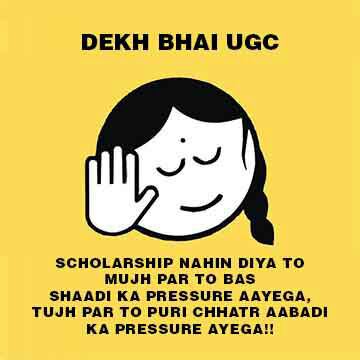
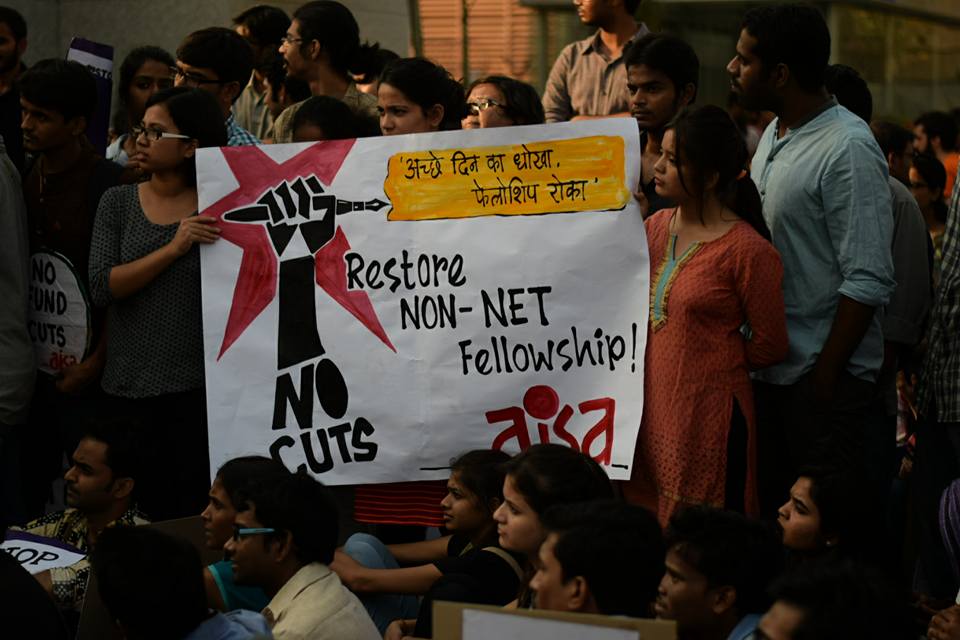
The Occupy UGC movement looks irrelevant or ridiculous to the middle and upper classes in India because it can be made to appear so by the media. Not surprisingly, television channels and leading dailies either ignored the protests altogether, or worse, focused on the apparently far more *critical* issue of the “vandalism” and “disfigurement” of the ITO metro station by the protesting students. Times of India said they were “brazening it out” after their acts of vandalism, and on social media including Kafila, these student vandals have been additionally belittled by some as misguided pawns in the hands of an apparent conglomerate of ambitious lefty professors from JNU! Basically, anything but a legitimate set of demands, some of which this poster from the movement tries to explain…

Dekh Bhai UGC

(Incidentally, it was this image that was painted on the walls of the ITO metro station. Personally I found it cheerful). 

Anyway, as Camalita Naicker reminded us in her excellent article on South Africa here on Kafila, student protests against rising student fees and shrinking scholarships and fellowships are no flash in the pan but a burgeoning worldwide phenomenon cutting across political affiliations. This is because you don’t need to be a leftist to understand that in contemporary conditions, pursuing a higher education is both the only guarantee to economic security, and the one thing that may be denied to you if you are from the wrong side of the tracks. 

We post below statements from #OccupyUGC and #Occupy SOAS in support of each other. These have been sent to us by Akash Bhattacharya, research scholar in history at JNU.

FROM #OCCUPYUGC:

Dear friends, We might be standing miles apart but it seems we are fighting a similar cause. We have heard how the students, teachers and staff at School of Oriental and African Studies, University of London have been relentlessly raising their voices against the discreet proposal of cuts in funds at the institute, scraping of courses which are tagged as ‘less relevant’ for the market , subsequent job losses, undemocratic governance and the undue suspension of Sandy Nicoll, Unison branch secretary, in its wake. While it throws open questions about the specific situation at SOAS, it, at the same time, exposes how the sphere of public education is getting increasingly tied with the functioning of capital and the implicit linkage between the University and Industry. We not only extend our solidarity to such an exposure by the students and staff at SOAS, we also salute the grit with which the struggle has taken place in the face of constant monitoring by the authorities. Here, in India we also have been fighting the sell- out of research and education. Recently, University Grants Commission, the highest governing body of the Universities in the country, had announced the scrap of a fellowship which is granted to the researchers who are pursuing M.Phil and Ph.D (a mere Rs 5000 and Rs 8000 respectively per month, lower than the stipulated minimum wage of the country) in the Central Universities. With the demand of :1)Reinstatement of the fellowship; 2) Enhancement of fellowship and 3) Extension of fellowship to all State Universities, we are in the midst of a struggle where we have occupied the entrance street leading to the UGC Headquarters building in New Delhi and which is doing rounds by the name of #occupyUGC. The space is inhabited by students and teachers of different Universities in the capital city, with slogans, postermakings, open-classes with teachers and cultural performances. Not just this, the whole of country is witnessing a wave of such protests. Facing the constant repression by the state authorities, the brutal police lathicharge and arrest which had already happened twice within these 12 days, we have only grown stronger and more resolved to take this movement forward in a creative way. In its 12th day now, we derive inspiration and courage from Occupy SOAS and extend solidarity to the protestors there. As the forthcoming WTO summit in December at Nairobi is going to discuss the market opportunity of education as a ‘tradable commodity’, the global resistance of students-teachers-staffs-workers in education sector should grow stronger with slogans for inclusive and equitable education. One world, one struggle Education is not for sale! In solidarity, #OccupyUGC New Delhi 02-11-2015

FROM #OCCUPYSOAS:

To OccupyUGC, We thank you for your letter. It would interest you to know that the Brunei Suite has been visited by several Indian professors and activists speaking about your cause, meaning that rather than standing miles apart, we have quite literally been side by side. During a recent lecture we hosted about the UGC protests, one academic taught us about the use of police violence against your endeavours, including lathi charges. As the situation evolves, we offer our continued support, particularly given the quickened pace of Indian neoliberalism following the election of Narendra Modi and the BJP. Our non-negotiable demands include (1) a guarantee of there not being job losses as a part of proposed budget cuts, (2) a wider democratisation of governance at our university, (3) an end to proposed course cuts, which affect entire departments, (4) an end to “outsourcing” (subcontracting to private companies) of non-teaching staff, (5) the beginning of an academic boycott of Israel, passed by referendum last year, and (6) an end to the university’s implementation of the Conservative Party’s PREVENT strategy of counter-extremism, as framed by the Counter-Terrorism Act of 2015. Despite the obvious differences of our respective political situations, OccupySOAS and OccupyUGC are mobilising similar energies in the face of continued opposition from market-driven factions that seek to redefine education as a commodity, and projection of state interests, rather than a public good to be accessed by all. Indian politics continue to advance in a combative direction. Religious and nationalist fundamentalisms have come to accompany the growth of market fundamentalism in the current neoliberal project. These trends are apparent across South Asia, and we want to inform you that members of its Diaspora in the occupation space have made it clear that they support what you are trying to achieve. Your continued struggle gives us hope for a better future. The strength and resilience of our opponents guarantees that our fight will not end here, and the World Trade Organisation summit in Nairobi next month is one of many opportunities for resistance. It pleases us to know that we will continue to work toward the same objectives. We agree passionately: one world, one struggle, education is not for sale! In complementary solidarity, we encourage you to be realistic, and demand the impossible. #OccupySOAS London 10 November 2015

Filmmakers return awards


Updated: October 28, 2015 20:26 IST

FTII protest: 10 filmmakers return National Awards

  • Filmmaker Dibakar Banerjee (second from left) speaks during a press conference in Mumbai on Wednesday. Mr. Banerjee and nine filmmakers, including Anand Patwardhan (third from left), Nishtha Jain (left) and Paresh Kamdar (right), have returned their National Awards. Photo: Samrat Chakrabarti
    The Hindu

    Filmmaker Dibakar Banerjee (second from left) speaks during a press conference in Mumbai on Wednesday. Mr. Banerjee and nine filmmakers, including Anand Patwardhan (third from left), Nishtha Jain (left) and Paresh Kamdar (right), have returned their National Awards. Photo: Samrat Chakrabarti

  • The Hindu

    “The I&B Ministry wants to retaliate against the students in any manner to break their strike,” says documentary film-maker Anand Patwardhan. File photo: Shanker Chakravarty

As the students of Film and Television Institute (FTII) called off their 139-day strike, 10 filmmakers including Dibakar Banejee and Anand Patwardhan, expressing solidarity with the students, on Wednesday returned their National awards.

The filmmakers were:

Dibakar Banejee, Anand Patwardhan, Paresh Kamdar, Nishtha Jain, Kirti Nakhwa, Harshavardhan Kulkarni, Hari Nair, Rakesh Sharma, Indraneel Lahiri, Lipika Singh Darai.

The Government of India must urgently reveal its committment to protect the freedom of expression of each citizen, a statement signed by these filmmakers read.

Announcing the decision at a press conference in Mumbai, Mr. Banerjee said, “I never thought I would return my award. I can say this, that if FTII’s ethos is protected and strengthened, then not only will I think of taking back my award but will hand out 10 other awards in joy.”

Mr. Banerjee also said the decision was not not politically motivated. “It is motivated by my conscience. I am returning this to try and raise attention of the people. If someone who watched my film and liked it, then he might watch this is in the press and say this guy is saying something. Maybe I should listen. He may also dismiss me. But this is what I can do and I am doing it.”

Veteran filmmaker Anand Patwardhan said: “I am more afraid today than I was during the Emergency because now there are roving gangs looking to do violence against anyone who speaks out. Our appeal is to the people, not the government. We want to be a part of the awakening that is happening around the country, like the scientists, artists and writers returning their awards.”

On returning her award, an FTII alumnus Nishtha Jain said, “National award is one of the few awards that are not corrupted and still hold up a high standards. Which is why this makes it painful.”

She added: “This is the beginning of my protest and not the end. We have to think of more clever ways of protesting.”

The statement

Government of India must urgently reveal its committment to protect the freedom of expression of each citizen. 

We, the undersigned, stand alongside the writers who have returned the country’s highest literary honour, and hereby return our National Awards. 

As filmmakers, we stand firmly with the students of FTII and are determined not to let them shoulder the entire burden of the protests. They have mounted a historic struggle and we urge others within our fraternity to come forward and carry this protest forward. 

Dibakar Banejee, 

Khosla Ka Ghosla (2007)

Oye Lucky, Lucky Oye (2009)

Anand Patwardhan, 

Bombay Our City (1984)

Paresh Kamdar, 

Rasyatra (1995)

Nishtha Jain, 

Gulaabi Gang (2014)

Kirti Nakhwa, 

Lost & Found (2008)

Harshavardhan Kulkarni, 

Lost & Found (2008)

Hari Nair, 

Sham’s Vision (1997)

Rakesh Sharma, 

Final Solution (2006)

Indraneel Lahiri, 

Aamar Katha, Story of Binodhini (2014)

Lipika Singh Darai 

Gaarud (2009)

Eka Gachha Eka Mainsha Eka Samudra (a tree a man a sea) (2012)

Kankee O Saapo (dragonfly and snake) (2013)